Application of Corundum-Mullite Saggers in the Magnetic Materials Industry: Real-World Case Insights
In the production of magnetic materials—such as ferrites, rare-earth magnets, and soft magnetic ceramics—sintering plays a critical role in determining the final microstructure and magnetic performance of the product. The quality of this sintering process is highly dependent on the choice of kiln furniture, particularly the sagger (or crucible) used to contain and support the material.
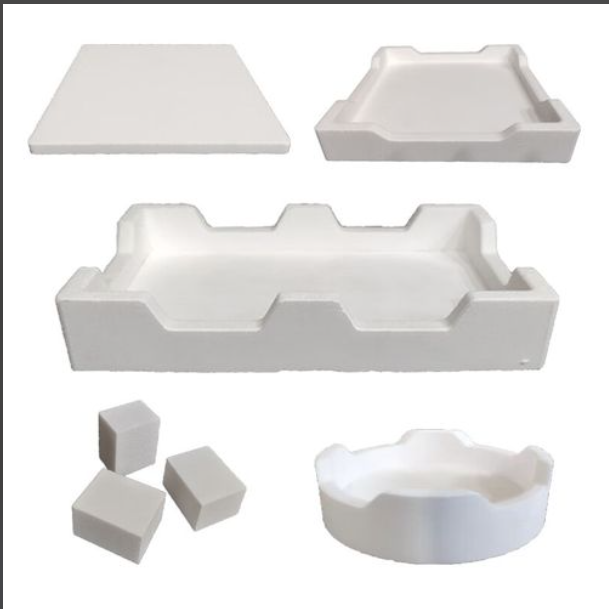
Among the various refractory materials available, corundum-mullite saggers have proven to be a robust, efficient, and cost-effective choice for magnetic materials manufacturing. This article explores the specific advantages, performance metrics, and case applications of corundum-mullite saggers in the magnetic material sector.
-
Understanding the Sintering Requirements of Magnetic Materials
Magnetic ceramics and powders typically undergo high-temperature sintering between 1,100°C and 1,400°C, depending on the composition and desired magnetic properties. Key requirements of kiln saggers in this process include:
Thermal stability under prolonged high temperatures
Chemical inertness to prevent contamination
Resistance to thermal shock due to multiple heating/cooling cycles
Dimensional stability to ensure uniform product sintering
Repeatability and long service life to reduce operating costs
Failures in any of these areas can lead to product cracking, impurity contamination, poor magnetic performance, and higher defect rates.
-
Why Corundum-Mullite Is Ideal for Magnetic Material Sintering
Corundum-mullite is a composite ceramic made from:
Corundum (α-Al₂O₃) – Provides high strength, hardness, and temperature resistance
Mullite (3Al₂O₃·2SiO₂) – Offers low thermal expansion and excellent thermal shock resistance
This unique combination enables saggers made from corundum-mullite to meet the demanding conditions found in the sintering of magnetic materials.
Material advantages include:
| Property | Benefit in Magnetic Material Processing |
| Max service temperature | ≥1,600 °C – Supports prolonged sintering durations |
| Low thermal expansion | Minimizes cracking under rapid heat cycling |
| Chemical inertness | Prevents reaction with iron oxides, cobalt, rare-earths |
| Mechanical strength | Withstands heavy stacking and powder loading |
| Lifespan | Typically 60–100 cycles under aggressive conditions |
-
Real-World Application: Soft Ferrite Manufacturing (MnZn & NiZn)
Application Context:
A leading Chinese manufacturer of MnZn ferrite cores for transformers and inductors was experiencing frequent cracking and deformation in their alumina-based saggers after only 30–40 sintering cycles.
Solution:
The company switched to corundum-mullite saggers with optimized wall thickness and reinforced edges.
Results:
Cycle life increased from 35 to over 90 firings
Contamination levels reduced, improving magnetic permeability consistency
Sagger weight reduced by 20%, leading to lower energy consumption per cycle
Uniform shrinkage of ferrite blocks due to stable sagger dimensions throughout service life
-
Real-World Application: Rare-Earth Permanent Magnet Sintering (NdFeB)
Application Context:
In the production of neodymium-iron-boron (NdFeB) permanent magnets, sintering is conducted at ~1,080–1,150°C under a controlled vacuum or inert atmosphere. The materials are highly reactive, especially at elevated temperatures.
Challenge:
Alumina or cordierite-based saggers introduced trace levels of Si and Fe contamination, reducing the coercivity of final magnets.
Solution:
A high-purity corundum-mullite sagger with a custom internal glaze and reduced open porosity was introduced.
Results:
Elimination of measurable Fe/Si contamination in final magnets
Improved coercivity and remanence consistency across batches
Average sagger life increased to 120 sintering cycles under vacuum conditions
Lower scrap rate (<1.5%), saving tens of thousands USD annually
-
Process Compatibility and Flexibility
Corundum-mullite saggers are compatible with various kiln types used in magnetic material production:
| Kiln Type | Performance of Corundum-Mullite Saggers |
| Shuttle kilns | Excellent thermal shock resistance and cycling behavior |
| Roller hearth kilns | Lightweight saggers reduce energy consumption |
| Tunnel kilns | High load-bearing strength under constant temperature |
| Atmosphere kilns | Chemical stability in inert, reducing, or vacuum atmospheres |
They are also compatible with sintering of:
Hexaferrites (BaFe₁₂O₁₉, SrFe₁₂O₁₉)
Spinel ferrites (NiZn, MnZn)
Rare-earth permanent magnets (SmCo, NdFeB)
Soft magnetic oxides and composites
-
Design Considerations for Magnetic Materials
To fully optimize the use of corundum-mullite saggers in the magnetic material industry, certain design parameters must be tailored:
Wall thickness: Optimized (8–15 mm) to balance thermal response and mechanical durability
Internal coating: Anti-stick glazes reduce powder adhesion and simplify cleaning
Shape: Rectangular or round depending on stacking and airflow requirements
Handles or rims: For automated loading systems in continuous kilns
-
Maintenance and Lifecycle Management
Even with superior durability, proper sagger care is essential:
Avoid overfilling with magnetic powders, which expand during sintering
Clean residual oxides periodically to prevent buildup and surface reactions
Preheat saggers if moving from ambient to hot kiln zones
Rotate usage to distribute thermal fatigue evenly across the fleet
Conclusion
The magnetic materials industry demands kiln furniture that can handle not just heat, but mechanical stress, chemical reactivity, and operational efficiency. Corundum-mullite saggers deliver on all fronts, offering a balance of thermal resistance, toughness, and long-term cost savings. With proven success in soft ferrite and rare-earth magnet production, they are fast becoming the preferred choice for sintering under challenging conditions.

Leave a Reply