
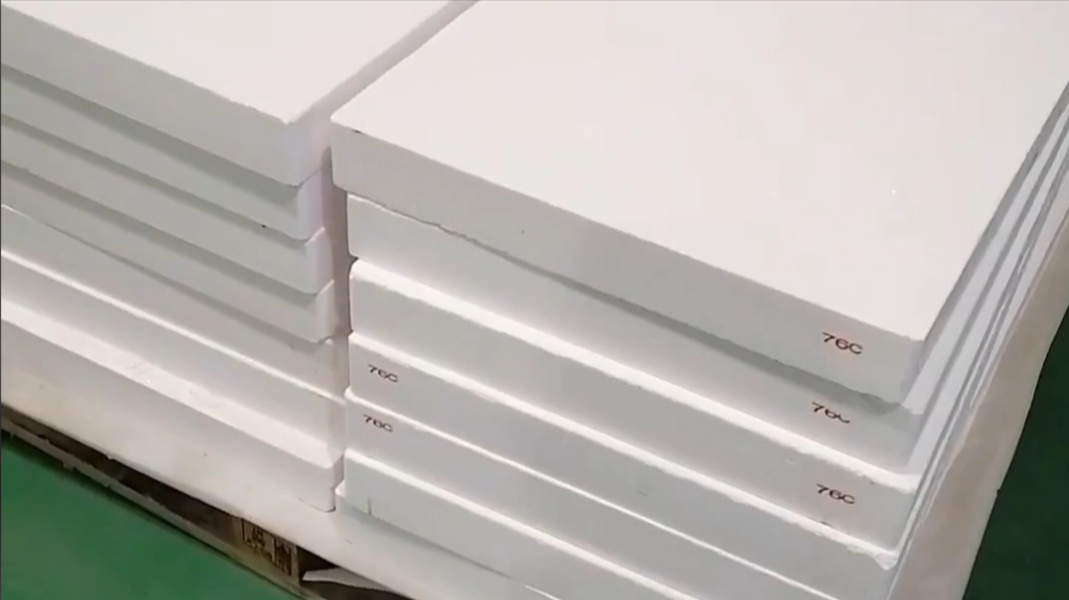
Unveiling the Manufacturing Process of High-Performance Corundum-Mullite Kiln Setter Plates
In high-temperature industrial processing, kiln furniture plays a critical role in supporting and separating products during firing. Among the various types of kiln furniture, corundum-mullite setter plates (also called kiln shelves or support plates) have garnered increasing attention due to their combination of thermal shock resistance, mechanical strength, and corrosion stability. This article explores the manufacturing process of high-performance corundum-mullite setter plates, focusing on material selection, forming, sintering, and quality control procedures that ensure exceptional performance in demanding applications such as electronic ceramics, lithium battery materials, and technical oxides.
-
Material Selection: Building a High-Performance Composite
The performance of a setter plate begins with raw material selection, which must be optimized for thermal, mechanical, and chemical resistance.
1.1 Corundum (α-Al₂O₃)
Used as the primary aggregate (50–70 wt%), providing high refractoriness (>1,900 °C), chemical inertness, and load-bearing strength.
Commonly used forms: tabular alumina, fused alumina, or reactive alumina.
1.2 Mullite (3Al₂O₃·2SiO₂)
Incorporated as a matrix phase (20–40 wt%), either in pre-synthesized form or developed in-situ during sintering through controlled Al₂O₃–SiO₂ ratios.
Offers low thermal expansion (~4.5–5.5 x10⁻⁶/°C), improving thermal shock resistance.
1.3 Additives and Binders
Binders: Phosphates, colloidal silica, or aluminum dihydrogen phosphate improve green strength.
Sintering aids: Small amounts of MgO, TiO₂, or ZrO₂ can improve densification or modify grain growth.
Lubricants/dispersants enhance particle packing and flowability for better forming.
-
Mixing and Homogenization
A homogeneous raw batch ensures consistent properties throughout the setter plate. The mixing process generally involves:
Ball milling or intensive paddle mixing to break agglomerates and achieve even distribution.
Moisture control to achieve optimal plasticity or flow for shaping (typically 4–8 wt% for semi-dry or plastic forming).
Sieving to remove oversized particles and ensure consistency in packing density.
Advanced manufacturers employ spray-drying for granule preparation, which improves pressability and reduces lamination defects during forming.
-
Forming Methods: Defining Shape and Density
Setter plates are typically flat and must maintain dimensional stability under repeated firing. Common forming techniques include:
3.1 Dry Pressing
Most widely used for plate thicknesses between 5–30 mm.
High-tonnage uniaxial pressing (100–400 tons) ensures uniform density and minimal warping.
Isostatic pressing can be used for specialty shapes or extra density uniformity.
3.2 Slip Casting or Gel Casting
Ideal for large-format or complex-shaped plates.
Slurry stability and mold release properties must be tightly controlled.
3.3 Tape Casting (for thin plates)
Enables formation of <3 mm thick setters used in precision sintering of thin ceramics.
Requires fine powders, dispersants, and organic binders to form defect-free films.
-
Drying and Pre-Firing
Controlled drying is critical to prevent cracking and distortion, particularly for large or thin plates. Typical steps:
Slow ramp-up to 110–150 °C with humidity control to avoid binder migration.
Drying duration: 12–48 hours depending on thickness.
Optional pre-sintering (bisque firing) at 800–1,000 °C to remove organic binders and improve handling strength.
-
Sintering: Consolidating Structure and Phase Formation
High-temperature sintering transforms the pressed or cast body into a dense, stable ceramic with defined phase structure.
5.1 Temperature Range
Final sintering temperatures range from 1,600–1,700 °C, depending on formulation.
Soaking time typically ranges between 3–6 hours to allow full mullite crystallization and phase bonding.
5.2 Atmosphere
Usually fired in air, though some applications (e.g., silicon nitride sintering) require controlled or inert atmospheres.
Controlled heating and cooling ramps (≤3 °C/min) minimize internal stresses and prevent microcrack formation.
5.3 Microstructure Development
Target: interlocked mullite needles within a continuous corundum matrix.
Excess glassy phase is avoided to prevent creep or softening under load.
-
Surface Finishing and Dimensional Control
To ensure high flatness and reduce the risk of product contamination or sticking:
Surface grinding or lapping may be used to achieve dimensional tolerances within ±0.1 mm.
Chamfered edges reduce stress concentration and minimize crack initiation.
Anti-stick coatings (e.g., spinel, ZrO₂) may be applied for special sintering tasks.
-
Quality Control and Performance Testing
Each setter plate undergoes strict quality checks to ensure it meets performance specifications:
| Test | Purpose |
| Bulk density & porosity | Indicates sintering degree |
| Cold crushing strength (CCS) | Confirms mechanical integrity |
| Thermal shock resistance | Cycles from RT to 1,200–1,400 °C |
| Flatness tolerance | Measured via laser or feeler gauges |
| SEM/EDS analysis | Confirms phase distribution and purity |
| Creep under load (CURL) | Evaluates high-temp dimensional stability |
Failure to meet specifications leads to rejection or downgrading for non-critical use.
-
Application and Operational Guidelines
Preheating before use (150–200 °C) improves thermal gradient accommodation.
Avoid direct flame impingement or uneven heating zones.
Rotate setter positions periodically in the kiln to ensure uniform wear.
Clean off any residues (e.g., flux, oxides) between cycles to prevent surface degradation.
Conclusion
The manufacturing of high-performance corundum-mullite setter plates is a highly controlled, multi-stage process that balances raw material chemistry, microstructure design, and thermal behavior. Properly engineered and manufactured plates offer long service life, resistance to warping and cracking, and compatibility with aggressive firing cycles.
Whether used in the production of high-purity alumina, electronic ceramics, or battery precursors, these setter plates provide the structural reliability and thermal efficiency modern industries demand. Investing in optimized production processes ensures superior kiln performance and long-term cost savings.

Leave a Reply