
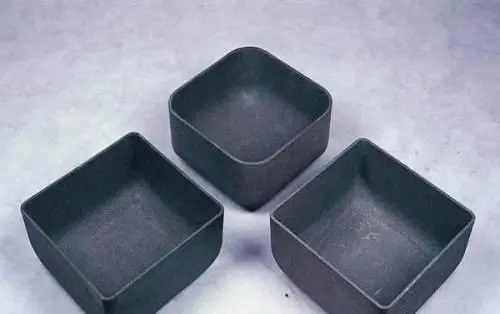
Introduction to Reaction-Bonded Silicon Carbide Saggers
Reaction Sintered Silicon Carbide (RBSC) crucibles are advanced ceramic materials produced through a chemical reaction and high-temperature sintering process. The production process is as follows:
Production Process
- Raw Material Preparation: The main raw materials are silicon carbide powder and free carbon. To improve the final product’s performance, binders and additives are also mixed into the composition.
- Mixing and Shaping: The silicon carbide powder, free carbon, and binders are thoroughly mixed, then shaped into a green body using processes such as extrusion, pressing, or casting. The resulting green body must have adequate mechanical strength and shape stability.
- Pre-Sintering: The shaped green body undergoes low-temperature pre-sintering to remove excess organic and volatile materials, increasing the green body’s strength and stability.
- Reaction Sintering: The pre-sintered body is then sintered at high temperatures in an inert gas or vacuum environment. During sintering, free carbon reacts with silicon to form silicon carbide, resulting in a dense SiC-SiC composite material. The sintering temperature generally ranges from 1350°C to 1450°C.
- Post-Processing: After sintering, the crucible may undergo additional post-processing steps such as machining, surface treatment, and quality checks to ensure it meets the required specifications.
Advantages of Reaction Sintered Silicon Carbide Crucibles
RBSC crucibles have several excellent properties that make them highly effective in high-temperature environments:
- High Strength and Hardness: RBSC materials have extremely high mechanical strength and hardness, allowing them to withstand harsh high-temperature and high-pressure conditions.
- Superior Thermal Shock Resistance: RBSC materials possess a low coefficient of thermal expansion and high thermal conductivity, providing excellent resistance to thermal shock and reducing the risk of cracking in rapidly fluctuating temperatures.
- Corrosion Resistance: RBSC materials show strong resistance to acid, alkali, and other corrosive chemicals, making them suitable for use in harsh chemical environments.
- Wear Resistance: Due to their high hardness, RBSC crucibles offer excellent wear resistance in high-temperature environments, extending their service life.
- Cost-Effectiveness: Compared to other high-performance ceramic materials, RBSC offers similar exceptional properties at a lower production cost, providing good economic value.
Applications of Reaction Sintered Silicon Carbide Crucibles
RBSC crucibles are widely used in several industries, including:
- Ceramics Industry: Used for high-temperature firing of ceramic products, such as porcelain, ceramic components, and refractory materials.
- Metallurgical Industry: Used in powder metallurgy processes for high-temperature sintering and the melting and refining of metals.
- Chemical Industry: Used in high-temperature reactors and equipment for handling corrosive media.
- Glass Industry: Used in the melting, annealing, and sintering processes in glass production, particularly for high-quality glass manufacturing.
- Semiconductor Industry: Used in the production of semiconductor materials and devices, such as single-crystal silicon and compound semiconductor materials.
Powders Suitable for Sintering in Reaction Sintered Silicon Carbide Crucibles
RBSC crucibles are suitable for sintering various high-temperature powder materials, including:
- Alumina Powder: Used to produce high-strength, wear-resistant alumina ceramics.
- Silicon Nitride Powder: Used to manufacture ceramics with excellent thermal shock resistance and oxidation resistance.
- Boron Carbide Powder: Used for producing wear-resistant and corrosion-resistant boron carbide ceramics.
- Metal Powders: Such as titanium alloys, nickel-based alloys, and others, for use in high-temperature sintering processes in powder metallurgy.
Temperature Suitability of Reaction Sintered Silicon Carbide Crucibles
RBSC crucibles are suitable for various high-temperature environments, with a typical operational temperature range of 1350°C to 1450°C. For special applications, RBSC crucibles that have been treated and designed properly can withstand even higher temperatures.
Conclusion
Reaction Sintered Silicon Carbide (RBSC) crucibles, with their excellent mechanical properties, thermal shock resistance, and corrosion resistance, have become essential materials in high-temperature industrial applications. Their wide use in the ceramics, metallurgy, chemical, glass, and semiconductor industries proves their reliability and cost-effectiveness in extreme environments. As technology continues to progress, the performance and application range of RBSC crucibles will expand further, providing stronger support for the development of high-temperature industries.
![Reaction Sintered Silicon Carbide Plate [MM-XG-SiC95]](https://moatcity.com/wp-content/uploads/2024/10/000.jpg)

Leave a Reply