Introduction to Pressureless Sintered Silicon Carbide Saggers
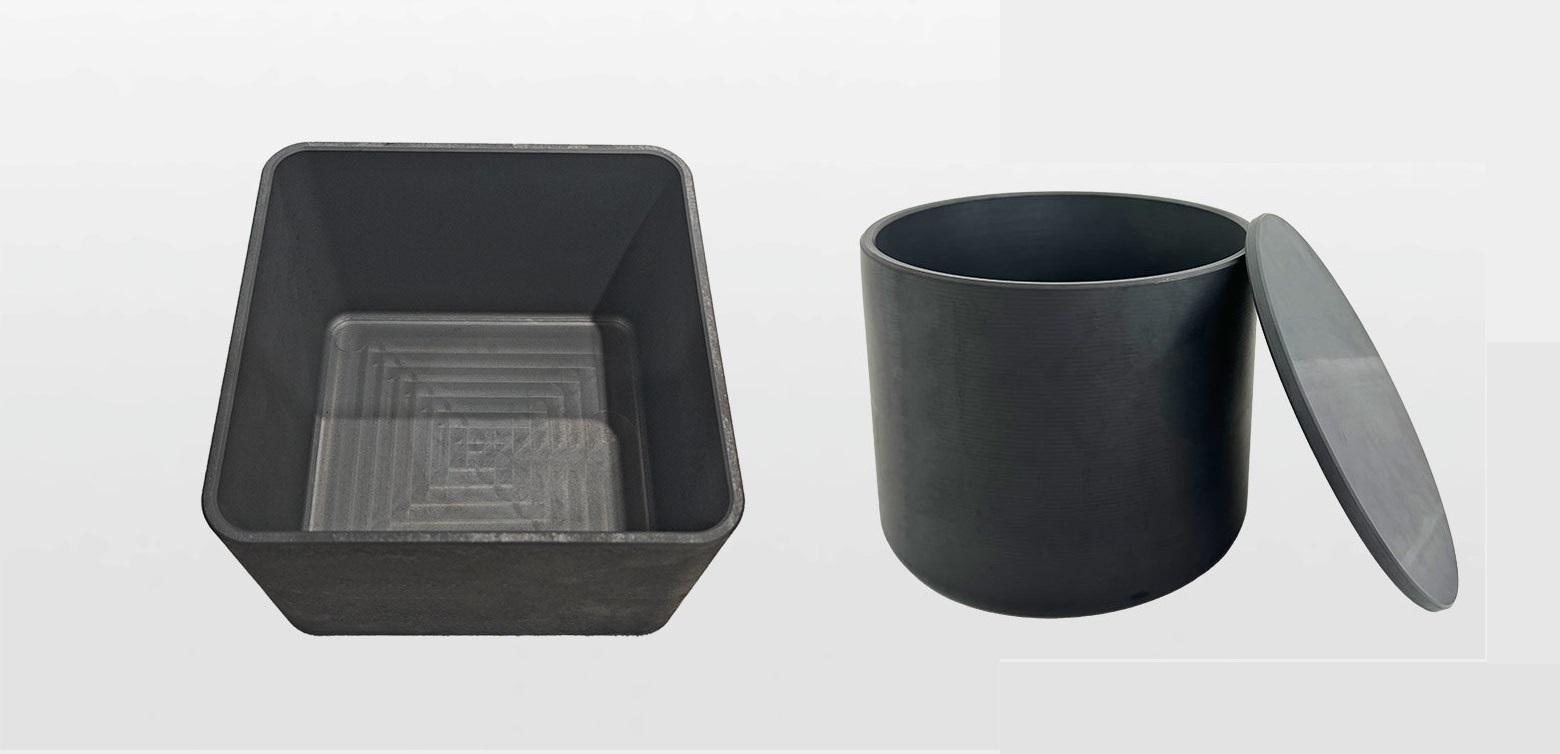
Pressureless Sintered Silicon Carbide (PSSiC) crucibles are high-performance ceramic materials produced through high-temperature sintering. The production process is outlined below:
Production Process
- Raw Material Preparation: The main raw material is high-purity silicon carbide (SiC) powder. To improve density and mechanical properties, small amounts of additives such as boron carbide (B₄C) and alumina (Al₂O₃) are typically added.
- Mixing and Grinding: The SiC powder and additives are mixed in specific proportions, followed by thorough grinding in a ball mill to achieve fine particle size and uniform distribution.
- Shaping: The uniformly mixed powder is shaped into a green body using Cold Isostatic Pressing (CIP) or slip casting. Cold isostatic pressing helps to ensure the body is dense and uniform.
- Drying: The shaped green body is placed in a drying chamber to remove excess moisture, preventing cracking during the sintering process.
- Sintering: The dried body is sintered at high temperatures (typically 2100°C to 2200°C) in an inert gas or vacuum environment. In pressureless sintering, silicon carbide particles bond together without the application of external pressure, resulting in high-density, high-mechanical-strength SiC material.
- Post-Processing: After sintering, the crucible may undergo additional processing steps such as precision machining, surface polishing, and quality inspection to ensure it meets the required specifications.
Advantages of Pressureless Sintered Silicon Carbide Crucibles
PSSiC crucibles have several excellent properties that make them exceptional in high-temperature environments:
- High Hardness and Strength: PSSiC materials exhibit extremely high hardness and mechanical strength, allowing them to withstand high-temperature and high-pressure conditions.
- Superior Thermal Shock Resistance: PSSiC materials have a low coefficient of thermal expansion and high thermal conductivity, performing exceptionally well in environments with rapid temperature fluctuations, reducing the risk of cracking.
- Corrosion Resistance: PSSiC materials have strong resistance to acidic, alkaline, and other chemical corrosive agents, making them suitable for use in harsh chemical environments.
- Wear Resistance: Due to their high hardness, PSSiC crucibles offer excellent wear resistance in high-temperature environments, thereby extending their service life.
- High Density and Uniformity: The pressureless sintering process produces high-density and uniform materials, ensuring the product’s performance and reliability.
Applications of Pressureless Sintered Silicon Carbide Crucibles
PSSiC crucibles are widely used in various high-temperature industrial fields, including:
- Ceramics Industry: Used in the high-temperature firing of ceramic products, such as porcelain, ceramic components, and refractory materials.
- Powder Metallurgy: Used for the high-temperature sintering of metal powders and ceramic powders.
- Glass Industry: Used in the melting and annealing processes of glass, particularly in the production of high-quality glass.
- Semiconductor Industry: Used in the production of single-crystal silicon and compound semiconductor materials.
- Chemical Industry: Used as high-temperature reactors and chemical equipment for processing corrosive and high-temperature media.
Powders Suitable for Sintering in Pressureless Sintered Silicon Carbide Crucibles
PSSiC crucibles are typically used for sintering various high-temperature powder materials, including:
- Alumina Powder: For producing high-strength, wear-resistant alumina ceramic products.
- Silicon Nitride Powder: For producing ceramics with excellent thermal shock resistance and oxidation resistance.
- Boron Carbide Powder: For manufacturing wear-resistant and corrosion-resistant boron carbide ceramics.
- Metal Powders: Such as titanium alloys, nickel-based alloys, and others, used in high-temperature sintering processes in powder metallurgy.
Temperature Suitability of Pressureless Sintered Silicon Carbide Crucibles
PSSiC crucibles are designed to operate in extremely high-temperature environments, typically ranging from 1600°C to 2200°C. Specially treated PSSiC crucibles can withstand even higher extreme temperatures.
Conclusion
Pressureless Sintered Silicon Carbide (PSSiC) crucibles, due to their excellent high-temperature and mechanical properties, have become essential tools in high-temperature industrial applications. From ceramics to semiconductor manufacturing, the versatility and reliability of PSSiC crucibles make them indispensable across various industries. As technology advances, the manufacturing process and performance of PSSiC crucibles will continue to improve, providing stronger solutions for the development of high-temperature industries.
![Silicon Carbide Saggars for Lithium Batteries [MH-LNY-LH-SiC73]](https://moatcity.com/wp-content/uploads/2024/10/01111.jpg)
![Reaction Sintered Silicon Carbide Plate [MM-XG-SiC95]](https://moatcity.com/wp-content/uploads/2024/10/000.jpg)

Leave a Reply