Illuminating Industry: R-SiC as Radiant Tubes in Heat Treatment Furnaces
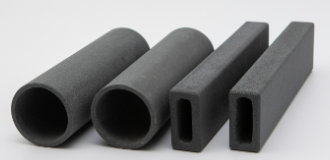
In the realm of industrial heat treatment, where precise temperature control and atmospheric integrity determine product quality, radiant tubes serve as the critical interface between heat source and process. Recrystallized Silicon Carbide (R-SiC) has emerged as the material of choice for these demanding applications, offering unparalleled performance in the most severe thermal environments. The use of R-SiC radiant tubes represents a technological leap in heat treatment efficiency, reliability, and process capability.
Radiant tubes perform the essential function of isolating combustion gases from the process atmosphere while transferring heat to the workload. This separation is crucial in applications requiring protective or reactive atmospheres, such as carburizing, nitriding, annealing, and sintering processes. Traditional metallic tubes, while adequate for lower temperature applications, face significant limitations as process temperatures increase. The mechanical strength of alloys decreases rapidly above 1000°C, leading to creep deformation, sagging, and ultimately failure. Oxidation resistance diminishes, and thermal expansion can cause distortion and sealing issues.
R-SiC addresses these limitations through its exceptional combination of properties.
The material maintains high mechanical strength up to 1600°C, far exceeding the capabilities of even the most advanced superalloys. This high-temperature strength prevents sagging and deformation under operating conditions, ensuring consistent tube geometry and reliable performance over extended service life. The significance of this property cannot be overstated – it enables heat treatment processes at temperatures where metallic tubes would fail catastrophically.
The thermal conductivity of R-SiC plays a equally crucial role in radiant tube performance. With thermal conductivity approximately ten times higher than heat-resistant alloys, R-SiC tubes achieve exceptional temperature uniformity along their length. This eliminates hot spots that can cause localized overheating and ensures consistent heat treatment results across the entire workload. The efficient heat transfer also improves energy efficiency, as more combustion heat is transferred to the process rather than being lost through the tube walls or exhaust.
The oxidation resistance of R-SiC provides another critical advantage. At operating temperatures, a protective silica layer forms on the tube surface, preventing further oxidation and degradation. This self-healing protective mechanism ensures long-term stability in oxidizing atmospheres, contrasting with metallic tubes that experience continuous oxidation and wall thinning. The result is extended service life and reduced maintenance requirements, with R-SiC tubes typically lasting several times longer than their metallic counterparts.
The application of R-SiC radiant tubes spans multiple heat treatment sectors. In the automotive industry, they enable high-temperature carburizing processes that enhance gear durability while reducing processing time. In the aerospace sector, R-SiC tubes facilitate the heat treatment of superalloy components requiring precise temperature control and atmospheric purity. The electronics industry utilizes these tubes in sintering processes where contamination must be avoided and temperature uniformity is critical.
The design of R-SiC radiant tubes has evolved to maximize these advantages. Modern tubes feature optimized wall thicknesses that balance mechanical strength with thermal efficiency. Special end fittings and sealing systems accommodate the different thermal expansion characteristics compared to metallic support structures. Advanced manufacturing techniques allow for complex geometries, including U-tubes and W-tubes, that maximize heat transfer surface area while maintaining structural integrity.
However, the implementation of R-SiC radiant tubes requires careful consideration of several factors. The material’s brittleness necessitates proper handling during installation and maintenance. Support systems must be designed to accommodate the tube’s weight while allowing for thermal expansion. Combustion systems may require adjustment to account for the different thermal characteristics, particularly the faster heat-up and cool-down rates enabled by R-SiC’s thermal properties.
The economic analysis of R-SiC radiant tubes demonstrates compelling advantages despite higher initial costs. The extended service life significantly reduces replacement costs and associated downtime. The improved energy efficiency lowers operating costs, while the enhanced temperature uniformity improves product quality and reduces scrap rates. Many users report payback periods of less than two years when converting from metallic to R-SiC tubes, with total cost of ownership reductions of 30-50% over the tube’s service life.
Recent advancements in R-SiC tube technology continue to push performance boundaries. Development of composite structures incorporating ceramic fibers enhances fracture resistance while maintaining thermal performance. Improved coating technologies provide additional protection against specific atmospheric conditions. Advanced joining techniques enable the creation of larger and more complex tube assemblies, expanding the range of applicable furnace designs.
The transition to R-SiC radiant tubes represents more than just a material substitution – it enables process improvements that were previously impossible. Higher operating temperatures allow for faster diffusion processes and new material treatments. Improved temperature uniformity ensures consistent product quality across entire batches. The reliability and longevity of R-SiC tubes reduce unscheduled downtime and maintenance requirements, increasing overall equipment effectiveness.
As heat treatment technology continues to advance toward higher temperatures, greater precision, and improved efficiency, R-SiC radiant tubes stand as enabling technology. Their unique combination of properties addresses the fundamental limitations of traditional materials, opening new possibilities in thermal processing while providing economic benefits through reduced operating costs and improved productivity.

Leave a Reply