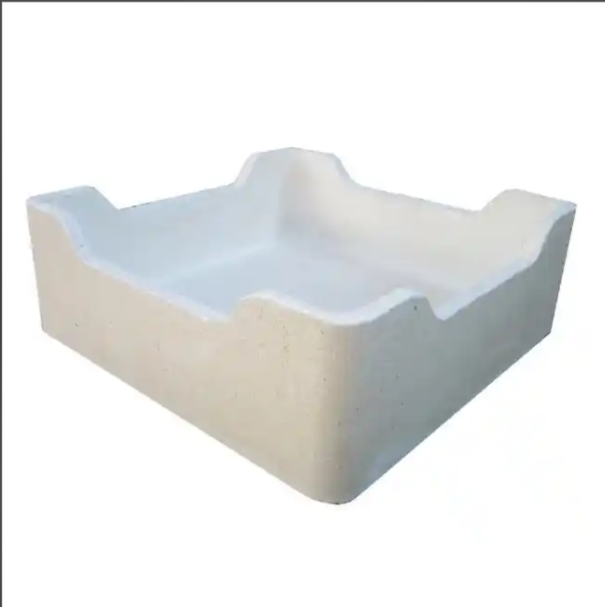
Corundum Mullite Refractory Boards: The Ideal Solution for High Temperature Furnaces
Corundum‑mullite composite refractory boards combine the exceptional thermal and mechanical properties of corundum (α-Al₂O₃) with the excellent thermal stability and cost-effectiveness of mullite (3Al₂O₃·2SiO₂). This type of composite board has emerged as a preferred choice in high-temperature industrial processes where durability, thermal shock resistance, and consistent performance are essential.
-
What Is Corundum‑Mullite?
A corundum‑mullite refractory consists primarily of two ceramic phases:
Corundum (α-Al₂O₃): A crystalline aluminum oxide with a density of approximately 3.9 g/cm³ and a melting point above 2,000 °C. It boasts high refractoriness, excellent mechanical strength, and outstanding resistance to slag and chemical attack.
Mullite (3Al₂O₃·2SiO₂): Formed in situ or added as a sintered phase, mullite has a lower density (~3.0 g/cm³) and melting point (~1,850 °C) than corundum. It offers superior thermal shock resistance, lower thermal expansion, and reduced thermal conductivity.
By marrying these two phases, one creates a synergy in which corundum confers load‑bearing capability and slag resistance, while mullite brings enhanced thermal shock resistance and cost optimization.
-
Why Choose Corundum‑Mullite Boards?
2.1 High Refractoriness and Mechanical Integrity
The inclusion of corundum ensures that these boards can endure temperatures up to approximately 1,750–1,900 °C, depending on makeup and binder system. At sub‑refractory temperatures (<1,600 °C), corundum-rich composites maintain high compressive strength—up to 70 MPa—and minimize softening under load creep. This makes them ideal for high-load zones in tunnel, belt, roller hearth, and tray kilns.
2.2 Thermal Shock Performance
Mullite acts to dampen thermal gradients and reduce the coefficient of thermal expansion. Tests indicate that with proper balance (~30–40% mullite), boards survive 30–40 full cycles of rapid heating between room temperature and 1,500 °C without macroscopic cracking. The fine‑tuned corundum/mullite microstructure prevents sudden fracture and therefore extends service life.
2.3 Slag and Corrosion Resistance
In applications handling aggressive melts (e.g., glass, non‑ferrous metals, or high‑alkali ceramics), the corundum constituent offers significantly better corrosion resistance compared to less dense alumina‑silica bricks. Mullite further provides a minimally reactive bonding phase, forming a more cohesive surface.
2.4 Cost‑Effectiveness
Pure corundum products are expensive due to the cost of high‑purity alumina raw materials. Blending with mullite lowers bulk density, reduces weight, and achieves savings—typically 10–30% over full corundum bricks—while maintaining acceptable thermal performance.
-
Typical Performance Specifications
| Property | Value (range) |
| Bulk density | 2.9–3.4 g/cm³ |
| Cold crushing strength (CCS) | 50–80 MPa |
| Refractoriness (Pyrometric Cone Equivalent) | 1,750–1,900 °C |
| Thermal conductivity (at 1,400 °C) | 1.8–2.5 W/m·K |
| Thermal expansion (25–1,400 °C) | ~6.5×10⁻⁶ /°C |
| Service temperature | Continuous: ≤1,650 °C; Peak: up to 1,800 °C |
These figures may vary according to raw materials, board thickness, and fired shrinkage. Excellent product lines are backed by proprietary sintering/bonding technologies that control porosity and phase distribution.
-
Manufacturing Process Overview
Proportioning: Typically 50–70% high‑purity corundum aggregate is combined with 30–50% tabular corundum, mullite powder, or reactive alumina–silica mix.
Binder & Additives: Mixtures often employ phosphoric acid, silica sol, or colloidal alumina as binders. Optional additives (e.g., plasticizers, dispersants) help with flow and green strength.
Forming Technique:
Dry Pressing: Most widely used for thicknesses > 30 mm.
Extrusion or Casting: Used for contour or thin plates.
Drying and Pre‑Firing: Slow drying at ~110 °C followed by pre‑firing in the 1,200 –1,500 °C range removes volatile binders.
Final Sintering: Executed at 1,600 –1,700 °C in gas/coal/electric kilns. Controlled soak times (~2–4 hours) and cooling rates minimize residual stresses.
Inspection & Quality Assurance: Boards undergo dimensional checks, ultrasonic/laser scanning, thermal shock testing, and acid/base leach resistance. Only boards meeting criteria are shipped.
- Key Application Areas
Ceramic Tunnel & Roller Hearth Furnaces: Used as bedplates, kiln shelf supports, or high-load sidewalls. Their stability improves firing uniformity and minimizes warping or sagging.
Glass Plate & Container Furnaces: Their corrosion resistance supports glass flow control in furnace bottoms and checker structures.
Metals & Superalloys Heat Treatment: Used in carburizing, nitriding, or hardening furnaces to protect trays or baseplates under cyclic thermal stress.
Technical Ceramics Production: Includes alumina, zirconia, alumina-mullite, and zirconia-silica ceramics—where surface contamination must be controlled.
-
Design and Application Guidelines
Board Thickness: Typically 20–60 mm; heavier boards carry more load but heat up slower.
Support Zone Design: Use integrated coolers or refractory pins to reduce surface temperature and thermal gradients.
Use of Expansion Joints: Gap spacers (~2–4 mm) help mitigate thermal expansion differences.
Upkeep & Re‑lining: Inspect boards for flaking, surface scaling, or edge erosion every 200–500 cycles. Replace individual sections rather than full kiln sections for cost efficiency.
-
Performance Optimization Examples
Chemical Additives: Incorporating ZrO₂ can increase thermal shock resistance via micro‑crack toughening.
Dense vs. Porous Grades: Dense boards perform better under heavy loads; engineered porous grades enhance insulating performance.
Hybrid Laminates: Some manufacturers layer high‑corundum facing surfaces over mullite-rich backing to optimize performance and cost.
Conclusion
Corundum‑mullite refractory boards offer an exceptional combination of high refractoriness, thermal‑shock resistance, and durability at a competitive cost. Their role in high‑temperature industrial systems is well‑established—from ceramics and glass furnaces to heat‑treatment kilns—especially when load‑bearing strength, temperature stability, and chemical resistance are vital.
For engineers and plant operators seeking reliable, long‑lasting refractory solutions, shifting from traditional alumina‑silica bricks to corundum‑mullite boards can enhance performance and reduce maintenance costs. Partnering with a qualified refractory supplier who can tailor composite chemistry, board geometry, and finishing standards will ensure optimal service and expanded furnace near-100% yield performance over operational cycles.

Leave a Reply