
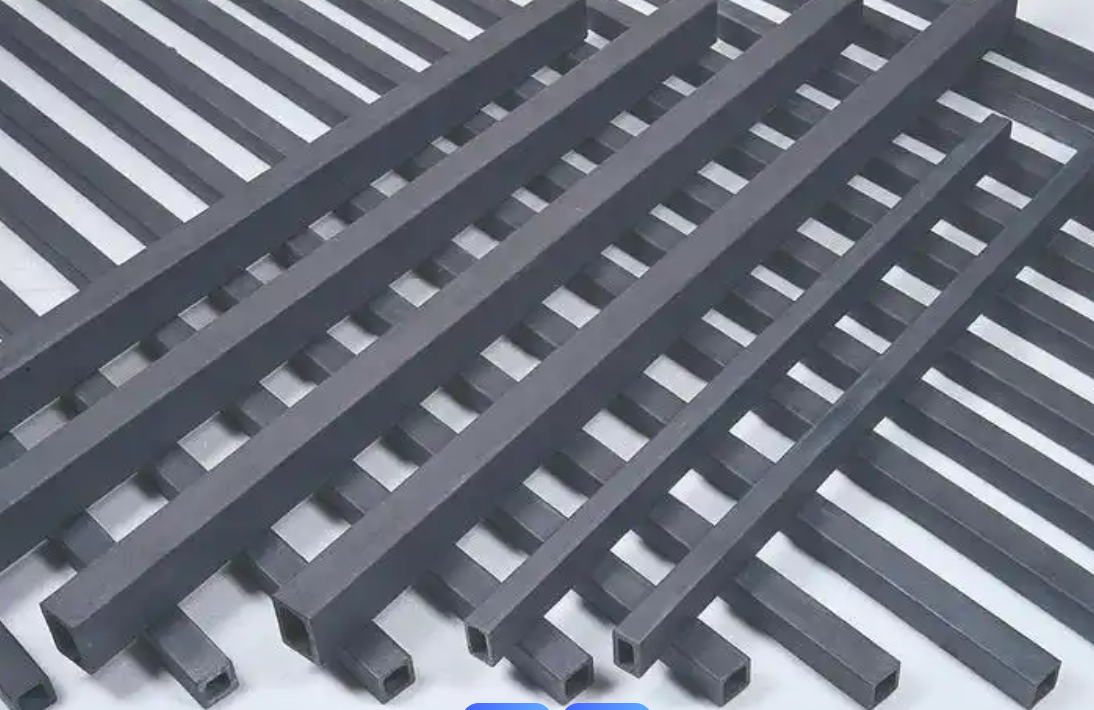
Analysis of the Thermal Shock Resistance of Recrystallized Silicon Carbide
Thermal shock refers to the stress caused by rapid temperature changes, which leads to uneven thermal expansion within a material, potentially resulting in cracks or even breakage. In industries such as metallurgy, ceramics, and glass, materials are often exposed to environments with severe temperature fluctuations. The thermal shock resistance of these materials directly influences their service life and stability. Recrystallized Silicon Carbide (RSiC), with its excellent thermal shock resistance, has found widespread application in high-temperature equipment operating under extreme conditions.
This article will focus on the thermal shock resistance of recrystallized silicon carbide, exploring its microstructural characteristics, factors affecting thermal shock performance, and how design optimization can enhance its resistance to thermal shock.
-
The Basic Principles of Thermal Shock and Its Impact on Materials
Thermal shock is typically caused by rapid temperature changes, leading to uneven thermal expansion within a material. Due to uneven thermal stress distribution, microcracks can form, which may ultimately lead to cracking, breaking, or pulverizing of the material. In refractory materials, poor thermal shock resistance typically results in:
Surface cracking: Uneven thermal expansion causes cracks to form on the surface, which can propagate over time;
Instability in thermal expansion: High and uneven thermal expansion coefficients lead to stress concentration;
Reduced strength: The formation of cracks reduces the material’s load-bearing capacity, preventing it from withstanding high-temperature stresses.
In industries like metallurgy and petrochemicals, materials are often subjected to environments with rapid and severe temperature fluctuations, particularly at locations such as furnace inlets and outlets, cooling zones, and reaction areas, where the effects of thermal shock are particularly significant.
-
Advantages of RSiC’s Thermal Shock Resistance
Recrystallized Silicon Carbide (RSiC) exhibits many excellent properties, especially its superior thermal shock resistance, which outperforms traditional refractory materials. The following are the key advantages of RSiC in terms of thermal shock resistance:
-
Low Thermal Expansion Coefficient
RSiC has a thermal expansion coefficient of about 4.5×10⁻⁶/K, which is significantly lower than other traditional refractory materials (e.g., high-alumina bricks and magnesia bricks). A lower thermal expansion coefficient means that RSiC is less affected by thermal stresses during heating or cooling, effectively reducing the formation and propagation of cracks.
-
Excellent High-Temperature Stability
RSiC maintains its structural integrity at high temperatures, typically between 1700°C and 1800°C. This makes it suitable for use in high-temperature environments, where it can withstand rapid temperature fluctuations without degrading in performance.
-
Microstructural Self-Adaptation
One of the key features of RSiC’s microstructure is its self-supporting particle structure. This structure helps alleviate thermal stresses at high temperatures and prevents crack propagation caused by uneven thermal expansion. This makes RSiC capable of withstanding extended exposure to high temperatures without losing stability.
-
High Thermal Shock Cycling Capacity
Experimental data indicates that RSiC can endure over 100 thermal shock cycles with a temperature differential (ΔT) of ≥1000°C, while other traditional refractory materials may only withstand 30–50 cycles. This feature makes RSiC ideal for use in high-temperature equipment subjected to frequent heating and cooling cycles.
-
Factors Affecting the Thermal Shock Resistance of RSiC
Although RSiC exhibits excellent thermal shock resistance, its performance is still influenced by various factors. The main factors affecting the thermal shock resistance of RSiC include:
-
Microstructural Characteristics
The thermal shock resistance of RSiC is closely related to its microstructure. Factors such as grain size, uniformity, and porosity directly impact its thermal expansion behavior. While larger grains may improve high-temperature strength, they can also concentrate thermal stresses, so controlling grain size and distribution can further enhance RSiC’s thermal shock resistance.
-
Heat Treatment Process
The manufacturing process of RSiC significantly influences its thermal shock performance. If the sintering temperature is not controlled properly, the material may develop an uneven microstructure, which affects its thermal expansion properties. Therefore, optimizing sintering temperature, time, and atmosphere can result in a more uniform and stable microstructure, thereby improving its thermal shock resistance.
-
External Environmental Factors
The thermal shock resistance of RSiC is also affected by its operating environment. For example, the rate of temperature change, the oxidizing or reducing nature of the atmosphere, and the speed of airflow all impact the thermal stress distribution in RSiC. In oxidizing environments, RSiC’s thermal shock performance may be affected by the oxidation layer, so surface treatments are necessary to enhance its durability.
-
Strategies to Enhance the Thermal Shock Resistance of RSiC
To further improve the thermal shock resistance of RSiC, the following strategies can be considered:
-
Optimizing Microstructural Design
By adjusting the grain structure of RSiC, thermal stress concentration can be reduced. For example, using fine grains and a uniform distribution of material helps mitigate the effects of uneven thermal expansion. Additionally, composite materials, such as combining RSiC with silicon nitride or alumina, can improve its shock resistance.
-
Surface Coating Technology
Applying high-temperature resistant coatings (e.g., carbon coatings or alumina-silica coatings) to the surface of RSiC can significantly improve its oxidation resistance and mitigate the impact of uneven thermal expansion. Coatings provide additional protection and help disperse thermal stresses, reducing the damage caused by thermal shock.
-
Controlling the Production Process
Precise control of the production process, especially during the sintering stage, can reduce the unevenness in the material. By optimizing the heat treatment process, a more uniform microstructure can be achieved, further enhancing thermal shock resistance.
-
Conclusion
Recrystallized Silicon Carbide (RSiC) is an excellent refractory material that, due to its low thermal expansion coefficient, excellent high-temperature stability, and superior thermal shock resistance, has found wide application in industries with extreme temperature environments. In high-temperature operations, RSiC performs exceptionally well in withstanding severe temperature fluctuations. By optimizing material microstructure, production processes, and surface treatments, the thermal shock resistance of RSiC can be further improved, allowing it to play a vital role in more high-temperature applications in the future.

Leave a Reply