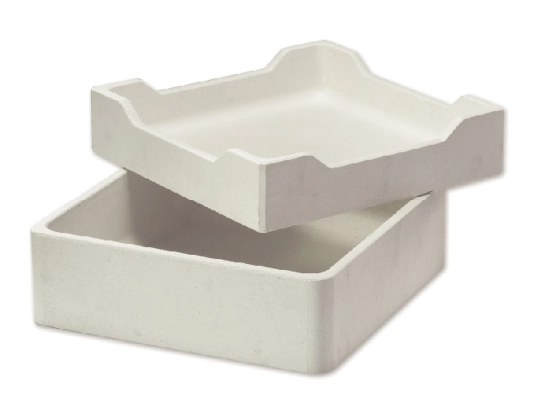
Alumina-Mullite Saggers/Crucibles: Ideal Choice for High-Temperature Sintering
Alumina-mullite crucibles offer excellent thermal stability and corrosion resistance, making them outstanding in high-temperature sintering processes. These crucibles are widely used across various industries. This article provides a detailed introduction to the processing technology, advantages, performance, suitable powder compositions, and applicable industries for alumina-mullite crucibles.
Processing Technology
The manufacturing process of alumina-mullite crucibles is complex and typically involves the following steps:
- Raw Material Preparation:
- High-purity alumina (Al₂O₃) and mullite (3Al₂O₃·2SiO₂) powders are selected to ensure material purity and consistency.
- Mixing and Shaping:
- The alumina and mullite powders are mixed in appropriate ratios, and the mixture is then shaped using hot pressing or isostatic pressing. This ensures the crucibles have high density and uniform structure.
- Sintering:
- The green body is sintered in a high-temperature furnace, usually at temperatures between 1500°C and 1700°C. The sintering process causes alumina and mullite particles to bond firmly, ensuring the crucible’s mechanical strength and thermal stability.
- Post-treatment:
- Depending on the requirements, precise machining and surface treatments are performed to achieve specific dimensions and surface smoothness.
Advantages and Performance
Alumina-mullite crucibles offer several key advantages due to their unique material properties:
- High Temperature Stability:
- Alumina-mullite materials exhibit excellent thermal stability, with minimal deformation or cracking at high temperatures.
- Superior Thermal Shock Resistance:
- These materials have a low thermal expansion coefficient and excellent thermal shock resistance, making them suitable for environments with rapid temperature changes.
- Chemical Corrosion Resistance:
- Alumina-mullite crucibles show strong resistance to most acidic and alkaline solutions, making them suitable for a wide range of chemical environments.
- High Mechanical Strength:
- Even under high temperature and pressure, these crucibles maintain excellent mechanical strength, ensuring their long service life.
Suitable Powder Compositions
Alumina-mullite crucibles are suitable for sintering a variety of high-performance powder materials, including but not limited to:
- Ceramic Powders:
- Such as alumina (Al₂O₃), zirconia (ZrO₂), silicon carbide (SiC).
- Metal Powders:
- Such as titanium, nickel, cobalt, and their alloys.
- Electronic Materials:
- Such as semiconductor powders (silicon, gallium arsenide, etc.).
Application Industries
- Ceramics Industry:
- Alumina-mullite crucibles are widely used in the ceramics industry for sintering structural ceramics, functional ceramics, and refractory materials. Their high-temperature stability and corrosion resistance ensure the quality and performance of materials during the sintering process.
- Metallurgical Industry:
- In the metallurgical industry, alumina-mullite crucibles are used for sintering various metal and alloy powders. Their high strength and thermal stability allow them to maintain their shape and performance under high temperature and pressure, making them suitable for producing high-temperature alloys and powder metallurgy products.
- Electronics Industry:
- In the electronics industry, alumina-mullite crucibles are used for sintering semiconductor materials and electronic ceramics. Their high purity and anti-contamination properties ensure the quality and performance of electronic materials during the sintering process. Additionally, their thermal stability makes them suitable for the manufacturing of integrated circuits, high-frequency components, and other precision electronic components.
- Chemical Industry:
- In the chemical industry, alumina-mullite crucibles are used for sintering various catalysts and chemical raw materials. Their resistance to chemical corrosion ensures long-term use in various chemical reaction environments.
Conclusion
Alumina-mullite crucibles, with their high-temperature stability, thermal shock resistance, chemical corrosion resistance, and high mechanical strength, are ideal choices for high-temperature sintering processes. Their extensive use in industries such as ceramics, metallurgy, electronics, and chemicals highlights their importance in high-temperature and advanced technologies. With ongoing advancements in technology, alumina-mullite crucibles are expected to demonstrate superior performance in more fields, driving the development of related industries.


Leave a Reply