
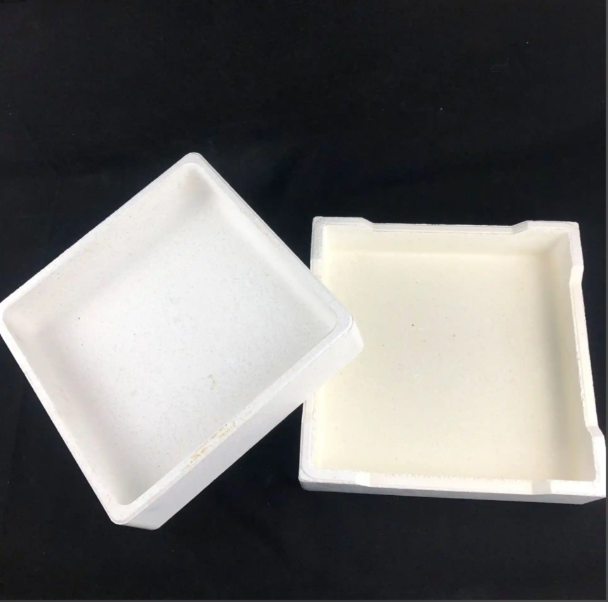
Thermal Shock Failure Mechanisms and Improvement Strategies for Corundum-Mullite Kiln Setter Plates
Corundum-mullite setter plates are widely used in high-temperature kilns to support and isolate ceramic products during sintering. Their popularity stems from an ideal balance of mechanical strength, thermal stability, and chemical resistance. However, thermal shock failure remains one of the most common and costly issues faced by users in fast-firing cycles or aggressive thermal environments. This article presents a detailed analysis of the mechanisms behind thermal shock failure in corundum-mullite setter plates, and offers practical strategies for improving service life and minimizing downtime.
-
Understanding Thermal Shock in Ceramic Materials
Thermal shock occurs when a material is rapidly heated or cooled, causing internal stress due to uneven thermal expansion or contraction. Ceramics are particularly sensitive due to their:
Low thermal conductivity → Surface and core heat at different rates
Low fracture toughness → Brittle failure under stress
Anisotropic grain structures → Localized stress concentrations
When these stresses exceed the material’s tensile strength, cracks initiate and propagate, leading to failure.
-
Corundum-Mullite Plates: Strengths and Limitations
Corundum-mullite combines the advantages of:
Corundum (α-Al₂O₃): High refractoriness (>1,900 °C), mechanical rigidity
Mullite (3Al₂O₃·2SiO₂): Low thermal expansion (~4.5–5.5 × 10⁻⁶/°C), high thermal shock resistance
However, under fast-firing conditions (e.g., >10 °C/min ramps), setter plates can still experience thermal fatigue and eventual cracking.
-
Failure Modes Observed in Service
Based on real-world kiln operations and microscopic failure analysis, the most common thermal shock failure patterns in corundum-mullite setter plates include:
3.1 Surface Microcracking
Initial cracks often begin at the hot face of the setter plate, where rapid exposure to heat causes a steep temperature gradient between the surface and interior.
Fine radial or network-shaped cracks
Typically <1 mm deep initially, but propagate over cycles
Lead to spalling, dust generation, or fracture
3.2 Edge and Corner Cracking
Corners and unsupported edges experience stress concentration during heating/cooling. This results in:
Vertical or L-shaped cracks
Chipping, warping, or full corner loss
More common in square or rectangular plates without edge rounding
3.3 Delamination or Layer Separation
In thicker plates, the mismatch in expansion between the hot surface and the cooler interior can cause layer separation or internal voids.
Sub-surface cracks visible on cross-section
Weakens load-bearing capacity
Can lead to catastrophic failure under thermal and mechanical stress
-
Root Causes Behind Thermal Shock Failure
Understanding the root causes enables targeted improvements:
| Cause | Description |
| High heating/cooling rates | Causes sharp thermal gradients across the thickness |
| Uneven heat distribution | Poor airflow or placement in kiln leads to local hot spots |
| Inadequate material composition | Excessive corundum increases stiffness but reduces thermal shock tolerance |
| Poor microstructure | Large grains or high porosity act as crack initiation sites |
| Improper handling or loading | Mechanical stress combined with thermal stress accelerates cracking |
-
Strategies for Improving Thermal Shock Resistance
5.1 Material Optimization
Balance between corundum and mullite is key:
Corundum (≥60%) provides mechanical strength
Mullite (30–40%) introduces flexibility and crack-deflection capability
Fine-grained, interlocked microstructure reduces crack growth
Additives like zirconia (ZrO₂) or titania (TiO₂) can enhance fracture toughness by promoting energy absorption at crack tips.
5.2 Microstructural Control
Use fine, uniformly distributed particles
Limit open porosity to <18% to prevent thermal shock crack paths
Avoid exaggerated grain growth during sintering by optimizing firing profile
Advanced processing methods, such as isostatic pressing and spray drying, can help achieve consistent density and homogeneity.
5.3 Design Improvements
Rounded corners and chamfers reduce stress concentrations
Use reinforced ribs or curvature in large plates to distribute stress more evenly
Introduce ventilation holes or grooves to reduce thermal mass and speed heat transfer
Thin-walled designs (<15 mm) are lighter and more responsive to temperature changes, reducing ΔT across the plate thickness.
5.4 Operational Best Practices
Preheat setter plates gradually before loading to eliminate thermal shock from ambient conditions
Avoid placing cold plates directly into hot zones
Ensure even airflow and flame distribution in the kiln
Use thermal insulation or buffer plates for high-ramp programs
Monitor and control ramp rates, especially during the initial heating phase and final cooling period.
-
Monitoring and Maintenance
Regular inspection helps detect early signs of failure:
Visual checks after each cycle for surface cracks or edge damage
Use acoustic emission or infrared thermography for internal damage detection
Clean residues (e.g., metal oxides or sintering flux) that may chemically weaken the surface
Establish a rotation schedule for setter plates to equalize exposure and wear across positions in the kiln.
-
Real-World Improvement Outcomes
Manufacturers who adopt these strategies have reported:
| Improvement Measure | Result |
| Material optimization | 30–50% increase in average plate life |
| Microstructure refinement | 60% reduction in early thermal cracking |
| Design upgrades (edges, thickness) | Lower failure rates and better weight distribution |
| Process adjustments (preheating, ramp rates) | Enhanced reliability across 80–100 sintering cycles |
Conclusion
Thermal shock failure in corundum-mullite setter plates can severely impact production yield and increase operational costs. However, by understanding the mechanisms of crack initiation and propagation, and implementing material, design, and process-based improvements, manufacturers can significantly extend plate life and maintain kiln performance.
Corundum-mullite remains an excellent choice for kiln furniture—but like any engineered component, it performs best when tailored and maintained according to application needs. Investing in smart design and proactive care leads to longer-lasting plates, higher productivity, and lower cost-per-cycle.

Leave a Reply